About SAMRoute
SAMRoute is a product line of Oriskami SAS. This page presents the company's information, scope, hosting, and the founder's background.
Company
SAMRoute is a product line of Oriskami SAS, founded in 2021 in Saint-Grégoire, Brittany, France. Oriskami SAS is accredited as a CIR R&D consultant by the French Ministry of Research (2022–2027; renewed 26 March 2025).
Legal entity: Oriskami SASSIREN: 892 745 969VAT: FR19892745969NAF: 7219ZFounded: 2021, Saint-Grégoire (35)CIR: 2022–2027 (renewed 26/03/2025)Jurisdiction: French law — Tribunal de commerce de Rennes
What SAMRoute produces
SAMRoute produces a structured reference dataset (référentiel) of the surrounding environment of critical infrastructure points — starting with level crossings (PN) across the French national rail network.
The référentiel covers 12,000 PN with approximately 200 metrics per point, describing surrounding context (demographics, land use, nearby emitters, road infrastructure, accident history) and functional dependencies (which traffic flows depend on which points, and what happens when a point is bypassed).
The result is a shared, comparable, auditable basis that teams can use to prioritise, review, and coordinate — across the full portfolio, not point by point.
The référentiel currently covers France (national rail network) and is extensible to other territories when data is available — initial datasets have been tested in Spain. It is built from sovereign and open sources: NASA GPW, Copernicus GHSL, ESA Worldcover, Eurostat, IGN RGE Alti, OpenStreetMap, Mapillary, ONISR, SIRENE, GTFS.
What SAMRoute is NOT
SAMRoute is a decision-support reference layer. It is not a live operational control system.
- Not a traffic management or control-command system. It does not operate in real time and does not replace ITS or signalling tools.
- Not a substitute for regulated safety processes. It complements existing methods, audits, and local studies — it does not replace them.
- Not a black box. The processing chain is traceable: data sources, versions, assumptions, and computation steps are documented and auditable.
- Not dependent on your internal data to start. The référentiel is built from open and third-party sovereign data sources. Internal data can be integrated later if useful, but is not required.
Hosting & sovereignty
All data is hosted and processed in France, under French jurisdiction. There is no dependency on non-EU infrastructure.
R&D infrastructure: Owned and operated by Oriskami SAS — Ille-et-Vilaine, FranceOperational hosting: OVHCloud — Roubaix / Gravelines, FranceGDPR: CompliantJurisdiction: French law — Tribunal de commerce de RennesSupport: Delivered from France
Timeline & maturity
- 2021 — Oriskami SAS founded (consulting: risk, data, R&D)
- Nov 2023 — SAMRoute product work started
- Sep 2024 — First functional demo
- Nov 2025 — Business demo live — 12K PN, ~200 metrics, built on feedback from SNCF Réseau field discussions
- Today — Working demo on real data, in active discussion with infrastructure stakeholders for first operational deployments
The référentiel runs on real data covering the French national PN portfolio. It is a working demo — not yet in production deployment. Metrics, documentation, and user workflows are being refined through ongoing exchanges with field experts.
Founder
Fabrice Colas has a research background in machine learning, human genetics, and epidemiology (PhD Leiden, postdocs at UCLA, UMC Utrecht, LUMC). He then built and shipped risk systems that recovered €2.3M in a live production environment (Travix International, Amsterdam). SAMRoute combines both: rigorous, reproducible methods applied to real infrastructure decisions.
Publications: SIGAPS score 58CIR accreditation: R&D consultant, 2022–2027Engineering: full-stack geospatial (JS, GIS, routing/OD modelling, Docker, k3s/k8s)

Explore SAMRoute in a live demo
Request sandbox access, or request a live exchange to tour the demo and map the next steps
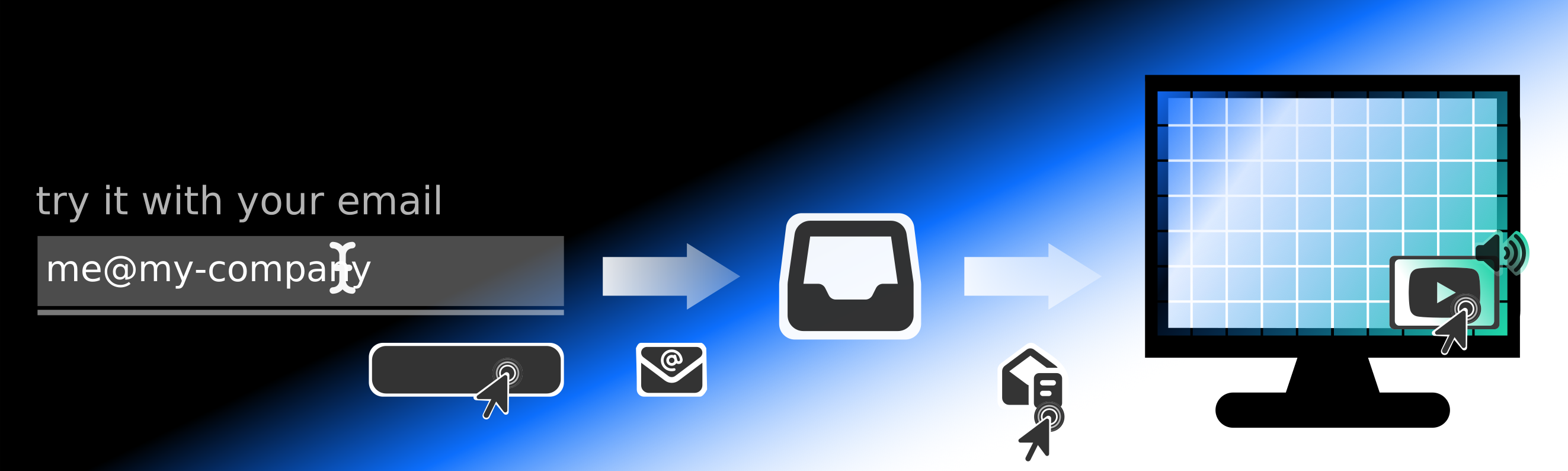
Enter your work email to get sandbox access and explore a real-world portfolio example. No sensitive data is needed.
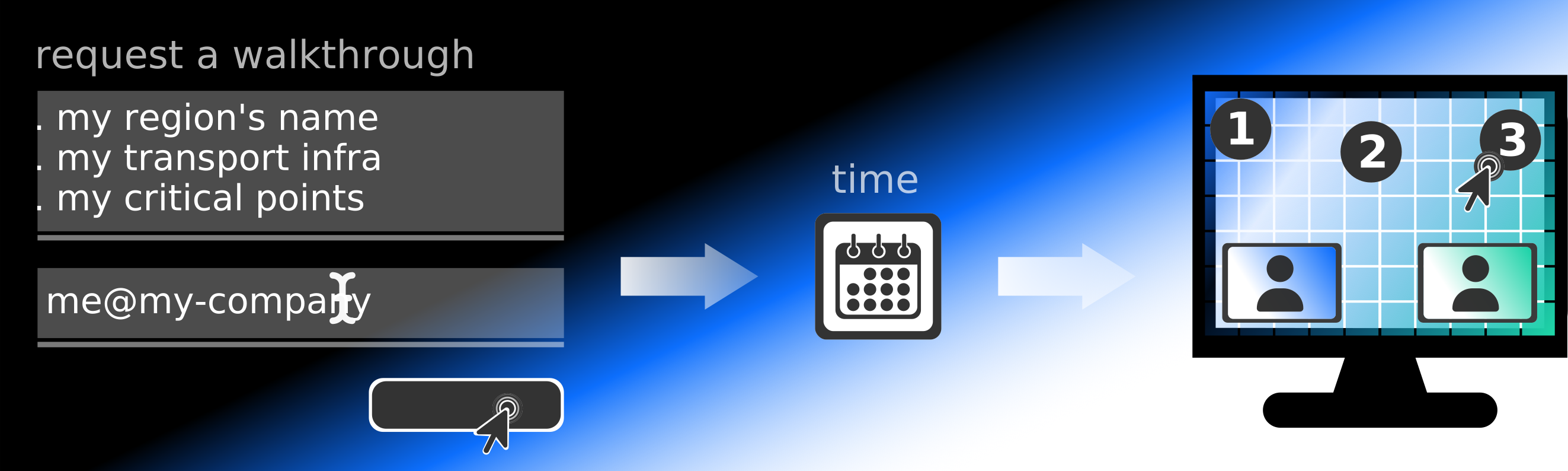
Prefer a guided walkthrough? Send a short note about your scope. We’ll start with a first call, then set up the next steps together.
Resources
Our resources
Our resources
Contact us
Our contact details/-1.7010147,48.1518939,2,0,0/520x240@2x?access_token=pk.eyJ1IjoiZmNvbGFzNjAxMyIsImEiOiJjbGx6NXo2bXUzMDhtM3BwOHZreXB0NWJmIn0.ERd5u_IkrKWSxriAu8CDBg)
Our contact details